Our Blogs
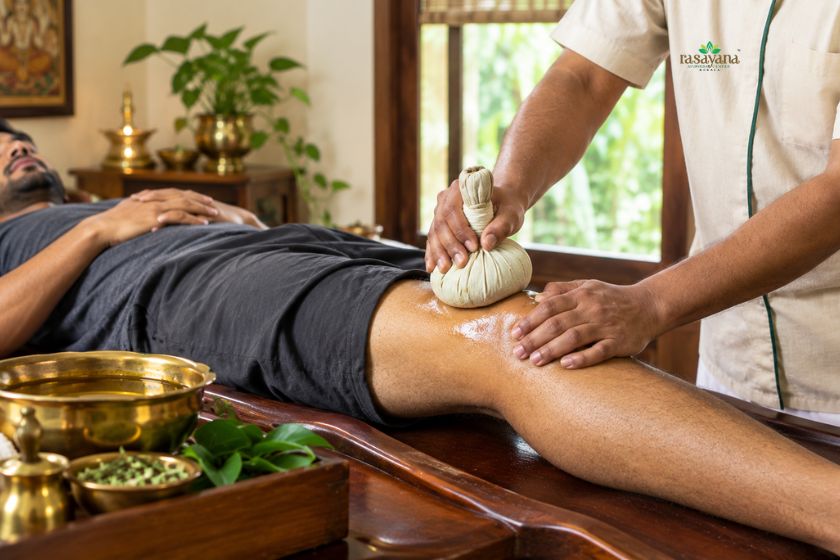
Ayurvedic treatments encompass a wide range of therapies and modalities. Here are some of the commonly practiced types of Ayurvedic treatments:
.jpg)
LONG WORKING HOURS IN MUMBAI: A MAJOR CAUSE OF CHRONIC BACK PAIN
When you think about Mumbai, the financial capital of India, you get a picture of a fast-paced city where people are rushing, busy with themselves, indulging in a back-breaking lifestyle driven by long working hours. Sometimes the term ‘backbreaking’ is not just a metaphor, it becomes too real, which is in turn, the chronic back pain. As a result, chronic back pain has become a common health concern among people in Mumbai who work long hours. A Mumbai-based survey shows that 36,783 chronic back pain patients often sit for 10-12 hours a day at work, adding to the incidence of the condition. Many office workers spend most of their time sitting in a position that creates spine strain. This increasing concern shows the importance of Ayurvedic treatment, so it becomes seeking back pain treatment in Kerala is not a mere option, but a necessity.
The Posture Problem – Silent Killer
Think about an average workday for a mid-level employee working in the offices in BKC or Lower Parel. From eight to ten hours spent hunching over a computer, hips misaligned in an office chair, with the shoulders slouching forward as the day progresses. The natural lordotic curve of the spine, which enables efficient load distribution, becomes progressively flattened. The muscles that are meant to do some of the work get weakened due to lack of use, and others end up strained. This creates a condition known as Katigraha in Ayurvedic terms - a condition characterized by pain, stiffness, and reduced mobility in the lower back.
This situation gets worse by commuting to and from work. While public transportation in Mumbai is remarkable for its capacity, it makes the commuters stand in uncomfortable postures for thirty to ninety minutes each way, holding onto overhead bars with one hand and shifting feet alternately on a moving suburban train.
The Influence of Stress
The significance of occupational stress is rarely discussed in this fast moving world. Ongoing stress from deadlines, performance pressure, and the non-stop nature of corporate life in Mumbai means that inflammation is not transient, but a constant occurrence. Deadlines lead to muscle tension. First, the trapezius muscle tenses up, then the erector spinae muscles. It takes several months or even years before the onset of back pain becomes noticeable.
The connection between mind and body is well known in the field of Ayurveda. According to the traditional medical system, the source of musculoskeletal pain lies in the disturbance of Vata dosha – the energy responsible for movement, blood circulation, and nerve impulses. Excessive intellectual activity, a nonstandard schedule, lack of rest, and stimulation affect Vata energy strongly. The city of Mumbai can be considered an ideal environment for the development of Vata imbalance, especially for those who are into the corporate work culture. The views are not in a critical viewpoint, because work is essential to lead a life, but our body must be given utmost importance. Just keep in mind the verse ‘Health is wealth’ – A sound mind only rests in a healthy body.
The Silent Accumulation of Damage
Back pain never occurs abruptly. One does not suddenly collapse. It develops gradually, a slight ache after a particularly long meeting, stiffness on Monday morning, a sharp ache that disrupts sleep. These warning signs are ignored and individuals rely on painkillers and other analgesics for relief, but most of them don’t know that these medicines just offer a temporary relief. This is an expensive move. Pain passes an information that the body is struggling with a problem.
Chronic back pain, when left untreated, becomes more complicated. Muscular strain may progress into problems such as a disc protrusion, facet joint irritation, or even nerve pressure causing radiating pain along the legs. When many people from Mumbai visit doctors, the problems would have grown more complex, needing persistent treatment.
The Ancient Science – The Holistic Approach
This is where Ayurveda provides what conventional pain killers simply cannot provide; a focus on the root cause of pain and not just treating symptoms. This treatment process is done in Rasayana Ayurveda Centre in Kochi, which is a NABH-accredited Ayurvedic hospital in Kochi with an expert team of experience doctors.
One of the most respected treatments for any ailment in Ayurveda is Kati Basti, which involves the accumulation of warmed medicated oil on the lumbar area, bound by dough. Through this, the warmth and medicinal effect of the oil work to reduce the swelling, it eases the spasms and slowly start to increase mobility. The technique known as Pizhichil involves the rhythmic application of warmed medicated oil all over the body.
The detox process can be extended up to Panchakarma procedures, which remove the Ama (toxins) responsible for exacerbating musculoskeletal problems. Basti, an enema procedure aimed directly at the Vata in its seat, is one of the most effective treatments available in the Ayurvedic pharmacopeia for spinal ailments. The Navarakizhi bolus massage, involving rice boiled with herbal decoctions, nurtures the tissues, builds up spinal muscle strength, and reduces pressure on nerves in a way that surgery cannot accomplish.
All of these procedures are not applied to every patient. Each guest who visits Rasayana is provided with a customized treatment regimen based on his/her prakriti (body constitution) and the particular nature of their ailment. That is, two individuals with the same problem may require different treatment procedures.
Structuring Lifestyle to Complement Medicines
In the Ayurvedic perspective, that treatment without a change in lifestyle would be an incomplete process. This is especially true for the working people of Mumbai, whose lifestyles have been the very cause of their sickness, which continues while they go through treatment.
In Rasayana therapy, the correction of Ahara, Vihara, Vichara, and Nidra becomes indispensable. In simple terms: warm home-cooked food replaces cold processed food that causes Vata imbalance; selected yogic poses such as Bhujangasana and Balasana bring back spinal flexibility and changes in ergonomics in the workspace help relieve the continuous strain, and finally, real rest – undisturbed rest enables the body to heal itself.
The center's residential treatment programs, conducted in a peaceful Kerala village, give the Mumbai resident exactly what it needs: peace, fresh air, natural rhythm, and no triggers for further tightening the nerves.
.jpg)
.png)