Our Blogs
Ayurvedic treatments encompass a wide range of therapies and modalities. Here are some of the commonly practiced types of Ayurvedic treatments:
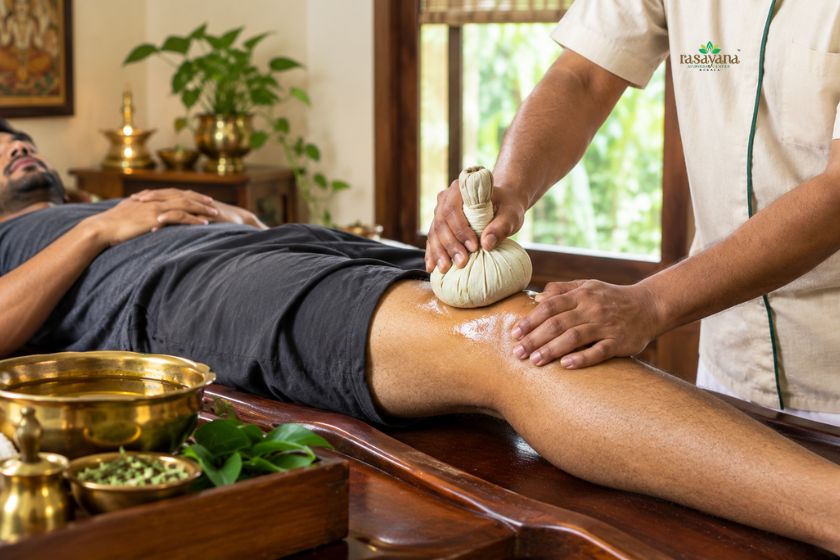
How Many Sessions of Panchakarma Are Needed for Knee Pain?
The number of panchakarma sessions needed in your case depends on the cause of pain, its severity, overall health, and treatment response. So, there is no specific number of sessions needed for knee pain. An Ayurvedic doctor may suggest a short-term or extensive course depending on the examination results. If you want to undergo panchakarma in Kerala for knee pain, first, understand your diagnosis and see whether the suggested treatments are beneficial.
Factors That Influence Therapy Duration
Since knee pain occurs due to various reasons, its treatment and prevention methods differ. For example, people with arthritis may need a slightly different therapy course compared to those with knee damage. An Ayurvedic doctor will prescribe a therapy, considering the symptoms’ nature and the patient’s overall well-being.
In addition, a specialist will take into account how long the discomfort has been present. Although long-lasting knee pain requires extended treatment, the number of panchakarma sessions is not directly related to the duration of discomfort. Thus, determining how many times one needs to undergo panchakarma is impossible without an individual assessment.
What Therapies Are Used To Treat Knee Pain?
Panchakarma is a comprehensive system that includes numerous treatment methods. After examining the patient, the doctor will choose which therapies affect the knees positively. For example, Abhyanga oil massage or Janu Basti treatment methods can be used.
A physician needs to examine and visually inspect the affected area to prescribe therapies. Taking into account the patient’s condition and accompanying diseases, the doctor will recommend a particular course and the number of sessions needed for one procedure. It is essential to note that scientific data about the effectiveness of panchakarma treatment for knee pain is limited. Therefore, this method cannot be considered a proven therapy and a complete replacement for conventional medicine.
How To Know If Treatment Is Effective?
Assess the effectiveness of the therapies during the session. During the procedures, it is necessary to monitor the pain, its localization, and the patient’s ability to move. In addition, observe whether the therapy affects the functionality of other body systems: if the procedures are properly selected and individual indications are taken into account, the negative impact on the circulatory system should be minimal.
If, after several sessions, the positive results are not noticeable, and the pain is as intense as before, the course should be canceled and the doctor’s consultation should be sought. With persistent discomfort, it is necessary to contact a specialist to identify the cause and determine the treatment strategy. If the knee is red, hot, and significantly swollen, or the person has a high fever or sudden pain, the doctor should be called immediately.
Conclusion
The number of panchakarma sessions needed for knee pain can only be determined by an Ayurvedic doctor. This is due to the complexity of the disease course, accompanying conditions, and individual indicators affecting the choice of therapy. If you want to receive high-quality and safe treatment, contact an experienced specialist who will explain which procedures are suitable for your case. An individual approach, as well as awareness of the capabilities and limitations of panchakarma, will allow you to receive the necessary care and fully understand the potential benefits of this system.
.jpg)
.png)