Our Blogs
Ayurvedic treatments encompass a wide range of therapies and modalities. Here are some of the commonly practiced types of Ayurvedic treatments:
.jpg)
Why Knee Pain Is Increasing Among Working Professionals in Pune
“Young adults in their 20s, 30s, and 40s are also complaining of joint pain due to working from home and eating a high-fat and sugar diet, along with those who have recovered from Covid-19”
- Economic Times, Health world
Pune being the growing business hub packed with IT hubs and various businesses, it is now home for software engineers, web developers, managers, consultants and entrepreneurs in which most of the workforce spend the lion share of their day in front of laptops and other gadgets for meeting their deadlines. Even though these groups contribute their best to the economy, a silent personal crisis is unfolding on the other side in the workplaces, home offices and other back offices across the city. It is the worrying rise of knee pain among working professionals in their 40s, 30s, and even in their late 20s.
Ayurvedic physicians are reporting an influx of at least 10 patients every month within the age bracket of 25-50, these young or middle-aged professionals usually complain about an uneasiness while rising from a chair, difficulties while climbing steps and pain on knees while walking only just a few metres and few of the cases are significantly worsened and they seek for ayurvedic treatment for knee pain for getting a relief from severe pain.
For most patients, their condition stems from their daily habits, like: -
1. Prolonged Sitting – The Sedentary Trap
An average Pune IT professional sits for 8-10 hrs normally, durations extend when nearing deadlines. Prolonged sitting exerts compressive force on the knee joints, it weakens the quadriceps and thigh muscles that support the joint and this reduces the synovial fluid circulation, synovial fluid acts as lubricant of cartilage, so, when this circulation is affected it leads to the wearing of the cartilage. If this becomes a daily occurrence it leads to joint stiffness, inflammation, and early-stage cartilage wear.
In the Ayurvedic point of view, prolonged inactivity aggravates Vata dosha- the energy governing movements and all structural joints in the body. When Vata accumulates in the joints due to suppressed movement, it manifests as dryness, stiffness, cracking sensations, and pain.
2. Urban Lifestyle & Silent Obesity
From the city’s quintessential vadapav to the platters offered at the multi-cuisine fast food outlets, Pune offers a dynamic menu to its people. Every nook and corner of the city is stuffed with food stalls, which is crowded almost all the time. This contributed to the steady increase in lifestyle-related weight gain. For every kilogram of body fat gained, the knee experiences roughly four times the added force during movement – The Multiplier effect.
In Ayurveda, the excessive weight gained from a sedentary life style and improper diet is related to the imbalance of Kapha Dosha, which when accumulated cause dull aching pain, sluggishness and difficulties with minor movements.
3. Stress - Cortisol – Inflammation
Stress developed from workplace tasks and competitions, combined with familial problems, wears us out. Chronic stress elevates cortisol, the primary stress hormone. If it's persistently elevated it could possibly lead to low grade inflammations. So, if you ever misunderstood that stress is only limiting your mental capabilities, no, it's not, its slowly eating out your joints, degrading cartilages and making the conditions worse.
Ayurveda interpreted this earlier and mentioned in the ancient texts as Manasika Vyadhi, which is a potential aggravator of Vata, that directly contributes to joint pain. Treating stress is never a luxury but a necessity while treating joint pain.
4. Nutritional deficiencies in the Fast paced Urban Environment
Late night works, familial problems, irregular sleep schedule and lot more. Majority of the population gives least importance to their diet. Instant noodles, sandwiches, hot dogs and instant fast food is taking over traditional idly, dosas, vegetable curries, pulses and cereal based foods. Besides dietary factors, working indoors all day and lacking exposure to direct sunlight can negatively affect Vitamin D levels. Calcium, Vitamin D, magnesium, and omega-3 fatty acids are all critical for maintaining cartilage health and reducing joint inflammation — and their deficiency could result in gradual degeneration of knee joints.
Ayurveda places great importance on Ahara (Diet). To pacify Vata - warm, nutrient-rich, and steam-processed foods are encouraged, while foods that exacerbate the condition are recommended to be avoided.
5. Weekend Warrior Syndrome – Hyper Activity After Inactivity
A peculiar type of trend is emerging among the working professionals, that is, they show interest for intense weekend exercise sessions after 5 days of near or complete inactivity. When a joint that has been sedentary all week is subjected to sudden intense activities, the chances of injuries and inflammation increase dramatically.
Ayurvedic Perspective of Knee Pain and its Treatments
Conventional medicine typically addresses this problem by painkillers, physiotherapy, and as a last resort, surgical intervention. These methods often mask the underlying reason. In Ayurveda, the goal is to identify the specific Doshic imbalance unique to each individual. We focus on clearing accumulated toxins from the joints, nourishing cartilages, and restoring the bodily balance so that the problem doesn’t reappear. A lot of clients across Kerala, Bangalore and Mumbai reach out for Rasayana in search of Ayurvedic treatment for knee pain in Kerala.
At Rasayana, our specialised treatment for knee pain includes: -
- Janu Basti: Therapeutic pooling of warm medicated oil over the knee joint that gives you relief from stiffness, reduces inflammation, and nourishes the cartilage — one of the most effective treatments for Vata-dominant knee complaints.
- Abhyanga (Medicated Oil Massage): Full-body warm oil massage that calms aggravated Vata, improves circulation to the joints, and helps in loosening accumulated toxins.
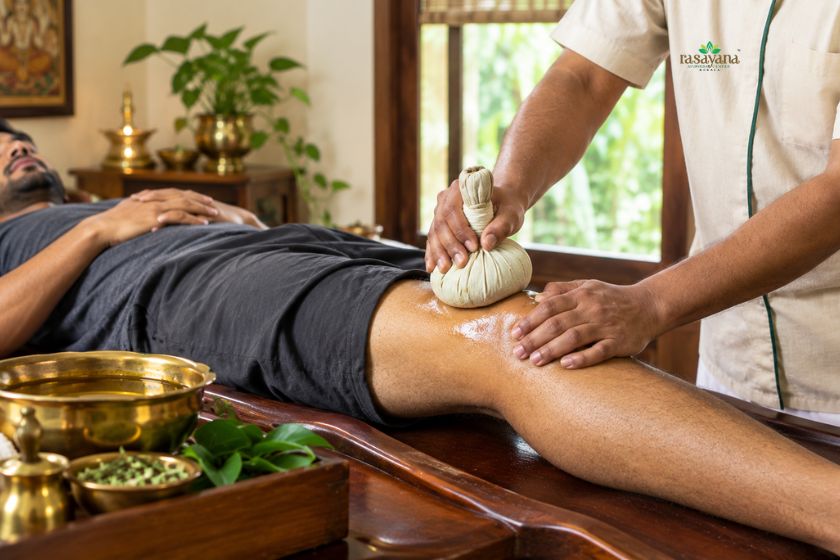
- Elakizhi & Navarakizhi: Specialised herbal bundle therapies that use warm medicated poultices to reduce swelling, ease muscle tension around the joint, and enhances tissue healing.
- Panchakarma Detoxification: A comprehensive internal cleansing programme that addresses the root cause of joint degeneration by eliminating deep-seated toxins (Ama) that block the channels nourishing joint tissue.
- Personalised Diet & Lifestyle Guidance: Tailored recommendations on Vata-pacifying diets, appropriate exercise and daily routines (Dinacharya) that support lasting joint health.
Remedies to Do
- Take a five-minute walk every hour during your work day
- Incorporate warm sesame oil self-massage (Abhyanga) on the knees before bathing, particularly in the cooler months when Vata aggravates.
- Favour warm, freshly cooked meals with turmeric, ginger, fenugreek, and ghee — all known in Ayurveda for their anti-inflammatory and joint-nourishing properties.
- Prioritise consistent, moderate exercise over sporadic intense activity.
- Seek an Ayurvedic consultation early — do not wait for mild discomfort to become chronic degeneration.
The Final Word
Knee pain is not simply a physical inconvenience — it is the body's eloquent signal that something in your lifestyle, diet, or inner doshic balance needs attention. In a fast-paced city like Pune, it is all too easy to silence that signal with a painkiller and return to the desk. But Ayurveda invites us to listen more carefully, to understand the message, and to respond with the depth and wisdom it deserves.
.jpg)
.png)